Complete engineering PPE guide covering mechanical, fabrication, welding, electrical engineering and maintenance workshops. Arc flash, welding hazards and compliance requirements.
On this page
Industry Overview
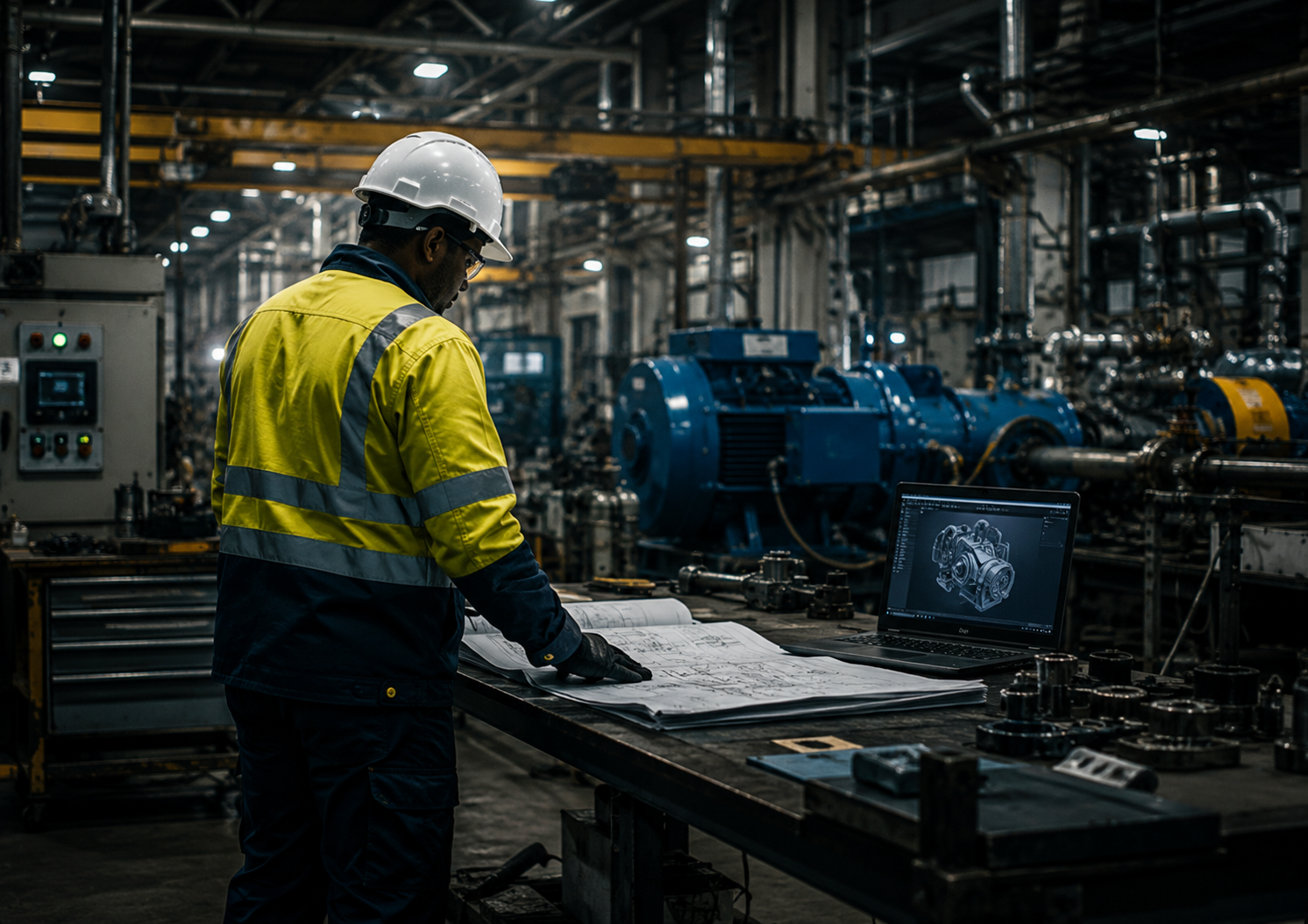
Engineering operations in South Africa span mechanical engineering workshops, fabrication facilities, welding operations, electrical engineering services, and industrial maintenance teams. These environments combine multiple high-severity hazards — electrical energy, thermal energy, mechanical energy, and chemical energy — often in close proximity within workshop settings.
The diversity of engineering tasks means that PPE requirements change throughout the day as workers move between welding, grinding, electrical work, assembly, and material handling. This dynamic hazard profile requires a task-based PPE approach rather than a single general specification.
Primary Workplace Hazards
Sparks and Flying Particles: Welding, grinding, cutting, and machining generate sparks, hot metal fragments, and abrasive particles at high velocity. Eye injuries from these hazards are among the most common in engineering workshops.
Welding Hazards: Arc radiation (UV, IR, visible light), welding fume (containing manganese, hexavalent chromium, and other toxic metals), spatter, hot metal, and fire risk. Each welding process (MIG, TIG, MMA, plasma cutting) has distinct hazard profiles.
Grinding Hazards: High-speed rotating grinding wheels can shatter, throwing fragments at extreme velocity. Grinding dust is respirable and can contain hazardous materials from the workpiece. Contact with the wheel causes severe abrasion injuries.
Arc Flash: Electrical faults in switchgear, panelboards, and distribution systems can generate temperatures exceeding 19,000°C, pressure waves, and intense light. Arc flash is one of the most lethal hazards in electrical engineering — it can kill at distances of several metres.
Electrical Hazards: Contact with live conductors, induced voltages, and capacitor discharge can cause electrocution, burns, and cardiac arrest. Voltage-rated gloves and insulated tools are essential controls.
Applicable South African Compliance Considerations
Occupational Health and Safety Act 85 of 1993: Applies to all engineering workshops. Section 8 general duties include providing safe systems of work, safe equipment, information, training, and supervision.
Electrical Installation Regulations: Under OHSA, these regulations govern electrical work and reference SANS 10142-1. They require that electrical PPE (insulated gloves, mats, tools) be tested and certified at prescribed intervals.
Pressure Equipment Regulations: Where pressure vessels and systems are worked on, these regulations apply with specific PPE requirements for testing and maintenance activities.
SANS Standards: SANS 50397 (head), EN 166 (eye), EN 175 (welding), EN 388/EN 407 (gloves), EN ISO 20345 (footwear), SANS 50149 (respiratory), IEC 61482 (arc flash), and SANS 60903 (electrical insulating gloves).
Legal vs Best Practice: OHSA requires PPE as a minimum. Best practice in engineering includes job safety analyses (JSAs) for each task type, arc flash incident energy calculations, and task-specific PPE selection matrices posted in workshops.
Recommended PPE Matrix
| PPE Category | Recommended PPE |
|---|---|
| Head Protection | Hard hat |
| Eye Protection | Safety spectacles, goggles or welding shields |
| Face Protection | Face shields for grinding and cutting |
| Hearing Protection | Ear protection where required |
| Hand Protection | Welding, cut-resistant or electrical gloves |
| Foot Protection | Heat and impact-resistant safety footwear |
| Respiratory Protection | Welding fume or dust protection |
| Arc Protection | Arc-rated clothing and PPE where applicable |
Detailed PPE Selection Matrix
| Hazard / Task | Recommended PPE | Relevant Standards | Inspection Frequency |
|---|---|---|---|
| Welding — arc radiation | Auto-darkening helmet, shade 9-14 depending on process/amperage; leather welding jacket | EN 175 / EN 379 | Daily |
| Welding — fume | Powered air-purifying respirator (PAPR) or FFP3 with welding fume filtration | EN 12941 | Daily; fit test annually |
| Welding — spatter | Leather apron, spatter-resistant sleeves, welding gauntlets | EN 11611 | Daily |
| Grinding | Face shield over safety glasses, grinding-rated gloves, leather apron | EN 166 / EN 388 | Daily |
| Arc flash (electrical) | Arc-rated shirt and trousers (ATPV calculated per IEEE 1584), arc flash hood, voltage-rated gloves with leather protectors | IEC 61482 / SANS 60903 | Daily; electrical test 6-monthly |
| Electrical contact | Class 00-4 insulating gloves (matched to working voltage), insulated tools, insulating mats | SANS 60903 / IEC 60903 | Pre-use; electrical test 6-monthly |
| Cutting (plasma/oxy-fuel) | Shade 3-5 cutting goggles, flame-resistant clothing, heat-resistant gloves | EN 166 / EN 11612 | Daily |
| General workshop | Safety spectacles (F-rated), S1-S3 safety boots, task-appropriate gloves | EN 166 / SANS 20345 | Daily |
Hazard Assessment Process
Engineering workshops require a task-based hazard assessment approach:
Job Safety Analysis (JSA): Each recurring task (welding a bracket, grinding a weld, replacing a motor, testing a panel) is broken into steps, with hazards identified at each step and controls specified — including PPE.
Arc Flash Hazard Analysis: For electrical workshops, incident energy calculations must be performed for each piece of electrical equipment to determine the Arc Thermal Performance Value (ATPV) required for protective clothing. This is not optional where workers may be exposed to arc flash.
Welding Fume Assessment: Quantitative air sampling for welding fume components (total fume, manganese, hexavalent chromium) determines the respiratory protection class required. Different welding processes and materials generate vastly different fume compositions.
Workshop Layout Review: The physical layout determines whether dedicated welding bays with local exhaust ventilation can be established, or whether workers must rely on respiratory PPE due to open workshop configurations.
PPE Hierarchy of Control
Engineering workshops must apply the full hierarchy:
Elimination: Remove the hazard. Example: Use pre-fabricated components to reduce on-site welding.
Substitution: Replace with safer alternatives. Example: Use TIG welding instead of MMA for reduced fume generation. Replace solvent degreasing with aqueous systems.
Engineering Controls: Isolate the hazard. Example: Welding booths with LEV, machine guards, arc flash containment, sound enclosures for grinding.
Administrative Controls: Safe procedures. Example: Permit-to-work systems for hot work, lock-out/tag-out (LOTO) for electrical work, scheduled maintenance to prevent equipment failure.
PPE: Personal protection. Example: Welding helmets where UV cannot be fully contained, arc flash suits where incident energy cannot be reduced below safe levels, hearing protection where grinding noise exceeds 85 dB(A).
PPE Selection Guidance
Welding Helmets: Shade selection depends on process and amperage: Shade 9 for low-current TIG, Shade 10-12 for general MMA/MIG, Shade 12-14 for high-amperage and plasma cutting. Auto-darkening helmets improve quality and reduce neck strain from nodding. Ensure the helmet meets EN 175 and the filter meets EN 379.
Arc-Rated Clothing: The ATPV (Arc Thermal Performance Value) must exceed the calculated incident energy at the working distance. Common ratings are 8 cal/cm² (Category 2) and 40 cal/cm² (Category 4). Never wear synthetic fabrics (polyester, nylon) under arc-rated clothing — they melt onto skin during an arc event. Only natural fibres or arc-rated base layers are permitted.
Electrical Insulating Gloves: Classified by maximum working voltage: Class 00 (500V AC), Class 0 (1,000V), Class 1 (7,500V), Class 2 (17,000V), Class 3 (26,500V), Class 4 (36,000V). Gloves must be electrically tested every 6 months at a SANS 60903-accredited facility. Always wear leather protector gloves over insulating gloves to prevent mechanical damage.
Respiratory Protection for Welding: In confined spaces or where LEV is inadequate, PAPRs provide the best combination of protection and comfort. For open workshops with good ventilation, FFP3 disposable respirators may be adequate. Fit testing is mandatory for all tight-fitting options.
Common Compliance Mistakes
1. No Arc Flash Assessment: Failing to calculate incident energy and specify appropriate arc-rated clothing. Workers may be wearing cotton workwear in a Category 4 environment — a fatal mismatch.
2. Wrong Welding Shade: Using a shade too dark for the process (reduces visibility) or too light (causes arc eye/flash burn). Shade must match the process and amperage.
3. Expired Electrical Gloves: Insulating gloves used past their 6-month electrical test date are non-compliant and potentially lethal. Colour-coded test date stamps must be visible.
4. Synthetic Clothing Under Arc-Rated: Workers wearing polyester t-shirts under arc-rated shirts. In an arc event, the polyester melts into skin causing worse injuries than the arc itself.
5. No Face Shield Over Glasses: Workers wearing only safety glasses during grinding. Face shields are required in addition to primary eye protection for grinding and cutting operations.
6. Missing Welding Fume Controls: Assuming general workshop ventilation is adequate for welding fume. In most cases, local exhaust ventilation or respiratory PPE is required.
PPE Inspection & Maintenance Guidance
Daily (Worker): Welding helmet — check lens for cracks, auto-darkening function, headband. Electrical gloves — air test (roll and trap air), check for punctures, cuts, ozone cracking. Face shield — check for scratches and cracks. Safety boots — sole and upper condition.
6-Monthly (Certified Test): Electrical insulating gloves — dielectric test at accredited facility. This is a legal requirement, not optional. Failed gloves are destroyed and replaced.
Annual: Arc-rated clothing — inspect for wear, contamination, and damage. Replace if arc rating may be compromised. Respirator fit testing — all tight-fitting respirator users.
Record Keeping
Maintain comprehensive records including:
- Arc flash incident energy calculations and equipment labelling
- Electrical glove test certificates (6-monthly)
- Welding fume assessment reports
- Job Safety Analyses for all recurring tasks
- PPE issue and training records
- Respirator fit test records
- Hot work permits
Compliance Responsibilities
Employer: Conduct arc flash assessments. Provide task-specific PPE. Ensure electrical PPE is tested and certified. Train on task-specific hazards. Maintain all records. Supervise compliance.
Employee: Follow JSAs and safe work procedures. Use specified PPE for each task. Inspect PPE before use. Report defects immediately. Attend all required training.
Frequently Asked Questions
Q: Is arc-rated clothing mandatory in South Africa?
OHSA Section 8 requires protection against all workplace hazards, including electrical hazards. Where arc flash hazard analysis indicates incident energy above 1.2 cal/cm², arc-rated clothing is the only acceptable protection. While not explicitly named in regulations, it is required by the general duty to protect against identified hazards.
Q: Can I wear my normal prescription glasses while welding?
No. Standard prescription glasses do not protect against UV radiation, IR radiation, or impact. Prescription welding helmets or safety glasses with appropriate shade filters must be used.
Q: How do I know what shade welding helmet to use?
Refer to SANS/ISO welding shade tables that correlate welding process and amperage to recommended shade numbers. When in doubt, start with a darker shade and adjust for visibility.
Q: What happens if electrical gloves fail the 6-month test?
Failed gloves are destroyed (cut up) and replaced. They cannot be repaired or re-tested. Always maintain a spare set to avoid operational disruption.
Key Takeaways
- Engineering PPE must be task-specific, not general workshop issue
- Arc flash hazard analysis is essential for electrical workshops
- Electrical insulating gloves require 6-monthly dielectric testing
- Welding shade must match process and amperage
- No synthetic clothing under arc-rated garments
- Welding fume assessments determine respiratory protection requirements
- Face shields are required over safety glasses for grinding
- Job Safety Analyses are the foundation of task-based PPE selection
Need Engineering PPE Solutions?
Sheq Safety supplies specialist engineering PPE including arc-rated clothing, welding protection, electrical safety equipment, and respiratory protection. Our technical advisors can conduct arc flash assessments, welding fume evaluations, and develop task-based PPE programmes for your workshop. Contact us for expert engineering safety support.
Recommended Catalogues
Related Knowledge Articles
 Workwear
The Complete Guide to Flame Retardant Workwear
Everything you need to know about flame retardant workwear: D59 treated cotton fabric technology, SANS and…
 Respiratory
 Protection in Hazardous Environments
Disposable masks to powered air systems — selecting, fitting, and maintaining respiratory protection for dust, chemicals,…
 Eye & Face
Eye and Face Protection Standards in South Africa
A detailed look at SANS and EN standards for safety eyewear, including impact ratings, optical classes,…
 Site Safety
Maintaining and Inspecting Your PPE: A Practical Protocol
Extend the life of your safety equipment and ensure consistent protection with proper inspection, cleaning, storage,…