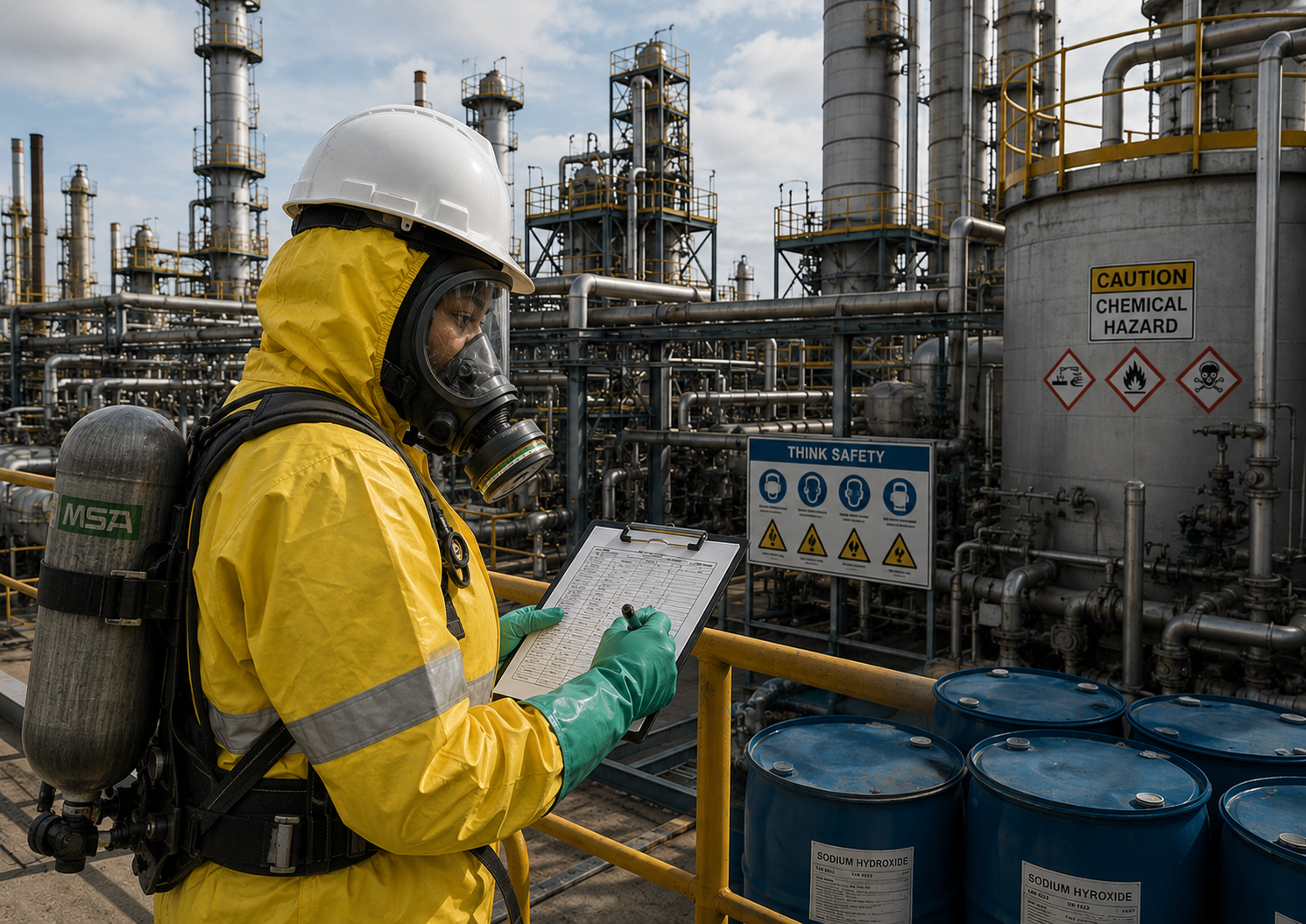
Complete chemical industry PPE guide for South Africa. Covers chemical manufacturing, storage, handling and hazardous substances. Major Hazard Installation Regulations and compliance requirements.
On this page
Industry Overview
South Africa’s chemical industry is one of the most developed in Africa, encompassing bulk chemical manufacturing, speciality chemicals, petrochemicals, agrochemicals, paints and coatings, adhesives, and chemical distribution and storage. Major chemical hubs are located in Sasolburg, Durban, Port Elizabeth, and the industrial areas of Gauteng. The industry handles a vast range of hazardous substances including corrosives (acids and alkalis), flammable liquids and gases, toxic chemicals, oxidisers, and reactive substances.
The chemical industry is the most heavily regulated sector in South Africa from an occupational health and safety perspective. Multiple overlapping regulatory frameworks apply, including the Major Hazard Installation Regulations, Hazardous Chemical Substances Regulations, and Dangerous Goods regulations. PPE selection in this industry is never generic — it must be precisely matched to each chemical hazard through systematic assessment.
Primary Workplace Hazards
Corrosive Chemicals: Strong acids (sulphuric, hydrochloric, nitric) and strong alkalis (caustic soda, caustic potash) cause severe chemical burns to skin, eyes, and respiratory tract. Concentrated corrosives can destroy tissue on contact within seconds.
Toxic Chemicals: Chemicals that cause systemic poisoning through inhalation, skin absorption, or ingestion. Examples include benzene, hydrogen sulphide, carbon monoxide, methanol, and numerous speciality chemicals. Many toxic chemicals have odour thresholds above their toxic levels — workers cannot smell them before being poisoned.
Vapours and Gases: Volatile chemicals generate vapours that can be flammable, toxic, or oxygen-displacing. Confined spaces in chemical facilities (tanks, reactors, vessels) present particular risks from vapour accumulation and oxygen deficiency.
Splashes and Spray: Filling, draining, mixing, sampling, and cleaning operations create splash and spray hazards. Pressurised systems create additional injection hazards where chemicals can be forced through the skin.
Fire and Explosion: Flammable liquids, gases, and dusts create fire and explosion risks. Static electricity, hot surfaces, sparks, and auto-ignition can initiate fires. Some chemicals are self-reactive or pyrophoric.
Emergency Response: Chemical spills, releases, and fires require emergency response personnel to enter hazardous environments with appropriate respiratory and dermal protection.
Applicable South African Compliance Considerations
Major Hazard Installation Regulations: Apply to facilities that store or process hazardous substances above threshold quantities. Require on-site emergency plans, risk assessments, and emergency response capability including appropriate emergency PPE.
Hazardous Chemical Substances Regulations (HCSR): Regulation 7 requires employers to assess exposure to hazardous chemicals. Regulation 9 requires control measures including PPE where exposure cannot be adequately controlled by other means. Regulation 10 requires monitoring of exposure levels.
OHS Act Section 8: General duty to provide a safe workplace, including provision of PPE where hazards cannot be otherwise controlled.
Dangerous Goods Regulations: Govern the transport and storage of dangerous goods, with implications for loading/unloading PPE requirements.
SANS Standards: EN 374 (chemical-resistant gloves), EN 943/EN 14605 (chemical protective clothing), EN 166 (eye protection), SANS 50137 / EN 137 (respiratory), and SANS 20345 (safety footwear with chemical resistance).
Recommended PPE Matrix
| PPE Category | Recommended PPE |
|---|---|
| Eye Protection | Chemical splash goggles |
| Face Protection | Full face shield |
| Respiratory Protection | Respirators selected according to hazard assessment |
| Hand Protection | Chemical-resistant gloves |
| Body Protection | Chemical-resistant suits or clothing |
| Foot Protection | Chemical-resistant safety footwear |
| Emergency PPE | Spill response and emergency equipment |
Detailed PPE Selection Matrix
| Hazard | Recommended PPE | Relevant Standards | Inspection Frequency |
|---|---|---|---|
| Chemical splash — eyes | Indirect-vented chemical splash goggles (not direct-vented) | EN 166 (liquid splash rating) | Daily |
| Chemical splash — face | Full face shield worn over goggles for significant splash risk | EN 166 | Daily |
| Toxic vapour / gas | Half-mask or full-face respirator with cartridges matched to specific contaminant; SCBA for IDLH | SANS 50136 / EN 136 / EN 137 | Daily; fit test annually |
| Skin contact — chemicals | Chemical-resistant gloves matched to SDS breakthrough data; chemical-resistant suit or apron | EN 374 (Type A/B/C) / EN 14605 | Per use |
| Foot chemical exposure | Chemical-resistant safety boots (PVC, nitrile, or neoprene upper); gaiters for splash protection | EN ISO 20345 with chemical resistance | Daily |
| Flammable atmosphere | Antistatic PPE; flame-resistant clothing; intrinsically safe communication equipment | EN 1149 / EN 11612 | Daily |
| Emergency response | SCBA, gas-tight suit (Type 1), chemical-resistant boots and gloves, two-way radio | EN 137 / EN 943 | Monthly |
| Oxygen deficiency / confined space | SCBA (never filter respirators); rescue harness with retrieval line | EN 137 / EN 1496 | Pre-entry |
Hazard Assessment Process
Chemical industry PPE selection is driven by the Chemical Hazard Assessment:
Chemical Inventory: Every chemical on site must be inventoried with its Safety Data Sheet (SDS). The SDS is the starting point for PPE selection, specifying required eye, skin, respiratory, and fire protection.
Exposure Assessment: Under HCSR Regulation 7, exposure assessments must be conducted for all hazardous chemicals. Air monitoring (personal and area) determines inhalation exposure. Dermal exposure assessment evaluates skin contact potential.
Task-Based Risk Assessment: Each chemical handling task (drumming, sampling, transferring, cleaning, maintenance) is assessed separately. The same chemical may require different PPE for different tasks depending on exposure potential.
Breakthrough Time Analysis: For chemical-resistant gloves and suits, breakthrough time data from the manufacturer must be reviewed. Breakthrough time indicates how long the material will resist the chemical before permeation occurs. Gloves must be changed before breakthrough time is reached.
PPE Hierarchy of Control
In the chemical industry, PPE is always the last resort after:
Elimination: Remove the hazardous chemical from the process. Substitute water-based systems for solvent-based systems.
Substitution: Replace with less hazardous chemicals. Use less toxic solvents, lower-concentration reagents, or less volatile alternatives.
Engineering Controls: Enclosed systems, ventilation (general and local exhaust), process isolation, secondary containment, automated handling, closed transfer systems.
Administrative Controls: Safe work procedures, permit-to-work systems (especially for confined space entry and hot work), exposure monitoring, health surveillance, batch control, inventory limits.
PPE: Personal protection where exposure cannot be fully controlled by other means. Chemical PPE must be selected based on SDS data and breakthrough testing — never guessed.
PPE Selection Guidance
Chemical-Resistant Gloves: No single glove material protects against all chemicals. Selection must be based on manufacturer chemical resistance charts matched to the specific chemicals being handled:
- Nitrile: Good for oils, greases, many solvents, acids. Poor for ketones, strong oxidisers.
- Neoprene: Broad chemical resistance, good for acids, bases, oils. Moderate solvent resistance.
- Butyl Rubber: Excellent for gases and ketones. Poor for oils and hydrocarbons.
- Viton: Broadest chemical resistance including aggressive solvents and acids. Premium price point.
- Laminate Films (Silver Shield/Viton-butyl): Highest chemical resistance for extreme hazards. Limited durability.
Glove thickness affects breakthrough time — thicker gloves provide longer protection but reduce dexterity. For tasks requiring fine motor control, thinner gloves with more frequent changes may be preferable.
Respiratory Protection: Selection follows the contaminant type:
- Particulates only: FFP2/FFP3 filtering facepiece
- Gases/vapours: Half-mask with specific cartridges (A for organic vapours, B for inorganic gases, E for acid gases, K for ammonia, combined types for mixtures)
- Combined particulate + gas: Combined filters (A-P2, ABEK-P3, etc.)
- IDLH or unknown concentration: SCBA only — never rely on filter respirators
- Oxygen-deficient atmosphere: SCBA only
Chemical Protective Clothing: Classified by type: Type 1 (gas-tight, for highest protection), Type 3 (liquid-tight, for pressurised liquid spray), Type 4 (spray-tight, for liquid spray), Type 5 (particulate protection), Type 6 (limited splash protection). Selection depends on the chemical state (gas, liquid, particulate) and exposure scenario.
Common Compliance Mistakes
1. Generic Chemical Gloves: Providing “chemical gloves” without specifying the material or verifying compatibility with site chemicals. Incompatible gloves provide a false sense of security while the chemical permeates to the skin.
2. Wrong Respirator Cartridges: Using organic vapour (A) cartridges for acid gas exposure, or particulate filters for vapour exposure. The cartridge must match the specific contaminant — there is no universal chemical filter.
3. Filter Respirators in IDLH: Using filtering respirators in oxygen-deficient atmospheres, confined spaces, or unknown concentrations. Filter respirators cannot provide oxygen and cannot protect against contaminants at concentrations above their design limit. SCBA is required.
4. No Breakthrough Time Monitoring: Using chemical-resistant gloves without knowing the breakthrough time for the specific chemical. Workers may be exposed through permeated gloves without knowing it.
5. Missing Emergency PPE: Having no SCBA, gas-tight suits, or spill response equipment on a site handling toxic chemicals. Major Hazard Installations are legally required to maintain on-site emergency response capability.
6. No Fit Testing: Tight-fitting respirators issued without fit testing. An unsealed respirator provides zero protection and creates dangerous false confidence.
PPE Inspection & Maintenance Guidance
Pre-Use (Every Time): Respirator — check face seal, straps, valves, filter expiry. Chemical suit — check integrity, zips, seams. Gloves — check for holes, cracks, degradation. Goggles — check seal, ventilation ports (ensure indirect vented for chemical use).
Monthly (Competent Person): SCBA — full functional test, cylinder pressure check, battery test, mask seal check. Gas-tight suits — pressure test (inflation test) for integrity. Emergency shower and eyewash stations — flow test and inspection.
Cartridge Replacement: Chemical filter cartridges have expiry dates and must be replaced before expiry. Change schedules must be established based on contaminant concentration, humidity, and breathing rate. Do not rely on smell or taste breakthrough — some chemicals cannot be detected before dangerous exposure.
Record Keeping
Chemical facilities must maintain extensive records:
- Chemical inventory with SDS for every substance
- Exposure assessment records (air monitoring, dermal assessment)
- PPE compatibility documentation (breakthrough times, manufacturer data)
- Respirator fit test records for every wearer
- PPE issue and change schedule records
- SCBA maintenance and test records
- Emergency drill records
- Health surveillance records where required by HCSR
Compliance Responsibilities
Employer: Conduct chemical exposure assessments. Select PPE based on SDS data and breakthrough testing. Provide appropriate PPE at no cost. Train employees on chemical hazards and PPE use. Maintain emergency response capability. Keep all required records. Conduct health surveillance where required.
Employee: Use specified PPE correctly. Inspect PPE before each use. Change gloves and filters per schedule. Report defects immediately. Attend all training. Participate in health surveillance. Never use filter respirators in IDLH or oxygen-deficient conditions.
Frequently Asked Questions
Q: Can the same chemical gloves be used for all chemicals on site?
No. Glove material must be matched to each specific chemical. A glove that protects against acids may be destroyed by organic solvents. Always consult manufacturer chemical resistance charts.
Q: How often must respirator cartridges be changed?
Cartridges must be changed before expiry dates, per the facility’s change schedule (based on usage conditions), when the wearer detects breakthrough (odour, taste, irritation), or after each use for highly toxic chemicals. Never rely solely on smell breakthrough.
Q: Is fit testing legally required in South Africa?
Yes. The Hazardous Chemical Substances Regulations and general OHSA duties require that tight-fitting respirators seal properly on the wearer’s face. Fit testing is the accepted method for verifying this seal.
Q: What PPE is required for confined space entry in chemical facilities?
SCBA (never filter respirators) is required when oxygen levels are below 19.5% or contaminants are present above safe limits. Full body harness with retrieval line, two-way communication, and a standby person with rescue capability are also required.
Key Takeaways
- Chemical PPE must be selected based on SDS data and breakthrough testing — never generic
- No single glove material protects against all chemicals
- Respirator cartridges must match the specific contaminant
- SCBA is required for IDLH, oxygen-deficient, and unknown concentration environments
- Filter respirators are never acceptable in oxygen-deficient atmospheres
- Breakthrough time determines maximum glove wear duration
- Major Hazard Installations must maintain on-site emergency response PPE
- Fit testing is mandatory for all tight-fitting respirators
Need Chemical Industry PPE Solutions?
Sheq Safety provides specialist chemical industry PPE including chemical-resistant gloves, suits, respiratory protection, SCBA systems, and emergency response equipment. Our certified technicians can conduct exposure assessments, respirator fit testing, and develop site-specific PPE programmes. Contact us for chemical safety expertise.
Recommended Catalogues
Related Knowledge Articles
 Respiratory
 Protection in Hazardous Environments
Disposable masks to powered air systems — selecting, fitting, and maintaining respiratory protection for dust, chemicals,…
 Site Safety
Maintaining and Inspecting Your PPE: A Practical Protocol
Extend the life of your safety equipment and ensure consistent protection with proper inspection, cleaning, storage,…
 Hand Protection
: A Comprehensive Guide to Industrial Gloves
Selecting the right gloves for chemical, mechanical, thermal, and electrical hazards — with cut resistance ratings,…
 Eye & Face
Eye and Face Protection Standards in South Africa
A detailed look at SANS and EN standards for safety eyewear, including impact ratings, optical classes,…